
Teaching Dogs Impulse Control
How to Teach Your Dog Impulse Control and Relaxation Skills
Discover positive ways to reduce hyperactivity and help your dog develop calm, confident habits.
Teaching your dog impulse control and relaxation skills is one of the most valuable ways to help them live a calmer, happier life.
Whether your dog jumps on guests, pulls on leash, or struggles to settle down at home, positive training methods can teach them to pause, think, and make better choices. By building these skills gradually and with plenty of rewards, you’ll help your dog feel more confident and less frustrated, making daily life more peaceful for both of you.
This article will show you practical strategies to encourage calmness and self-control in any situation.
IMPULSE CONTROL AND TEACHING YOUR DOG TO RELAX
Although some dogs are more high energy than others, it’s good for all dogs to learn how to calm themselves. It may surprise you to know that calming behavior can be taught. In fact, there are so many ways to teach calming behavior that it’s hard to know where to start.
Arousal
One good place would be arousal. Without realizing it, we enable our dog’s hyperactive lifestyle. For example, our dogs bark out the windows, fence fight, and go to dog parks. The chemicals released during arousal stay in our dog’s system for up to twenty-four hours. Then, we wonder why our dogs can’t calm down.
Here are a few ideas. For dogs that bark at everything that moves outside the house, you can use baby gates to keep the dog out of that room with the big picture window, close the blinds, or put up a Decorative Arts window film (sold at Home Depot or Lowe’s) that lets you, but not your dog, see out.
If you know that there are certain times when your dog is aroused—when the bus drops off kids after school or the trash trucks make their rounds—you can also put on classical music or a white noise machine to block out some of the commotion.
Instead of going to dog parks, play fetch or tug or set up a playdate with one compatible “friend”.
Default Behaviors
Default behaviors are what your dog does when he isn’t sure what else to do.
To teach a default behavior, like sit or down, have pea-sized treats at home in your pocket or treat bag or stashed around the house. Whenever you see your dog do something you like (let’s say sit), out come the treats. Remember that you aren’t cueing your dog to sit. You are rewarding a behavior that your dog does on his own.
Your dog will start sitting a lot because he has been rewarded for doing it. At that point, the treats can become random, and, once it’s clear that sit is your dog’s default behavior, you can start replacing the food reward with a belly rub or toy.
What’s so great about sit as a default behavior? Well, how often have you seen a dog “over the top” while sitting? Not very often, because sitting and going bananas can’t really happen at the same time. So we say that Sit is an “incompatible” behavior, and it’s the first step toward relaxation.
Taking Breaks
It’s true that dogs need exercise, but too much arousal without breaks can do more harm than good. It’s great if your dog can romp with a friend in your yard, play fetch, chase bubbles, play tug, or get through your home-made obstacle course. Don’t forget, though, to stop the fun and take frequent breaks. This not only tamps down your dog’s state of arousal, it also teaches your pup to transition from excitement to calm. After a break, let your dog play some more, so that he is more likely to accept later breaks without complaint.
Don’t expect your dog to come to you while he’s in the midst of playing if he hasn’t mastered his “recall” (come when called) in a distraction-free environment first. After you have a 100% reliable recall inside, then in a quiet environment, your dog will be more likely to come to you—especially if he has learned from experience that coming to you doesn’t always mean the end of fun. Until you’re sure that he’s going to be able to comply with your recall request, go get him if you need him to stop playing.
Reinforcing Behavior You Want
If you haven’t used a clicker, you should try it. Here’s why: When your dog is being rowdy, it’s so much easier to click a second of calm, followed in a few seconds by a treat, than to catch your dog’s moment of quiet without a clicker. By the time you give your dog a treat, without the click first, your dog may be wound up again and think that he is being rewarded for his crazy behavior. It’s just hard to get the timing right.
How do you get started? Click/treat, click/treat ten times until it’s clear that your dog understands that the click means a treat is coming. Your dog doesn’t have to do anything while you teach him what the clicker is. After that, you can use the clicker to identify either a skill or a behavior that you want. For example, if you are teaching sit, you click when your dog’s butt hits the ground … followed by the treat. When you want your dog to stop jumping, you click the moment your dog has all four feet on the floor… followed by the treat. Remember, dogs will repeat behaviors that are rewarded.
If you have trouble with the clicker or if your dog is afraid of the sound, you can use a word, like “YES”, or click with your mouth. When you read “clicker” in this handout, you can substitute either of these, or any other consistent sound you can use to mark a desirable behavior.
Once your dog knows what you want, you can make the food rewards random, and sometimes replace the food with praise or petting. However, when you are in a particularly distracting environment, like a public event or family picnic, you may need to crack out those special treats again.
Two other cautions: Don’t stop using the clicker too soon. And when you move away from food, make sure that your praise is in a soft voice and that your petting is slow and gentle.
Not Reinforcing Behavior You Don’t Want
We all do it. Our dog grabs something, and we chase him to get it back. He jumps on us, and we give him attention. We give our dog food when he begs at the table.
We do the same thing when our dog acts crazy. We don’t ignore the behavior and keep going. We yell at, push away, or try distracting our dog to keep him quiet … especially when we’re on the phone. It’s human nature!
Try something new. Ignore the behavior that drives you crazy. If you come home to a “nutso” dog, keep walking. If your dog jumps on you, no talking, looking at, or reaching for your dog. Turn away and wait. When he stops jumping, click and treat.
Management
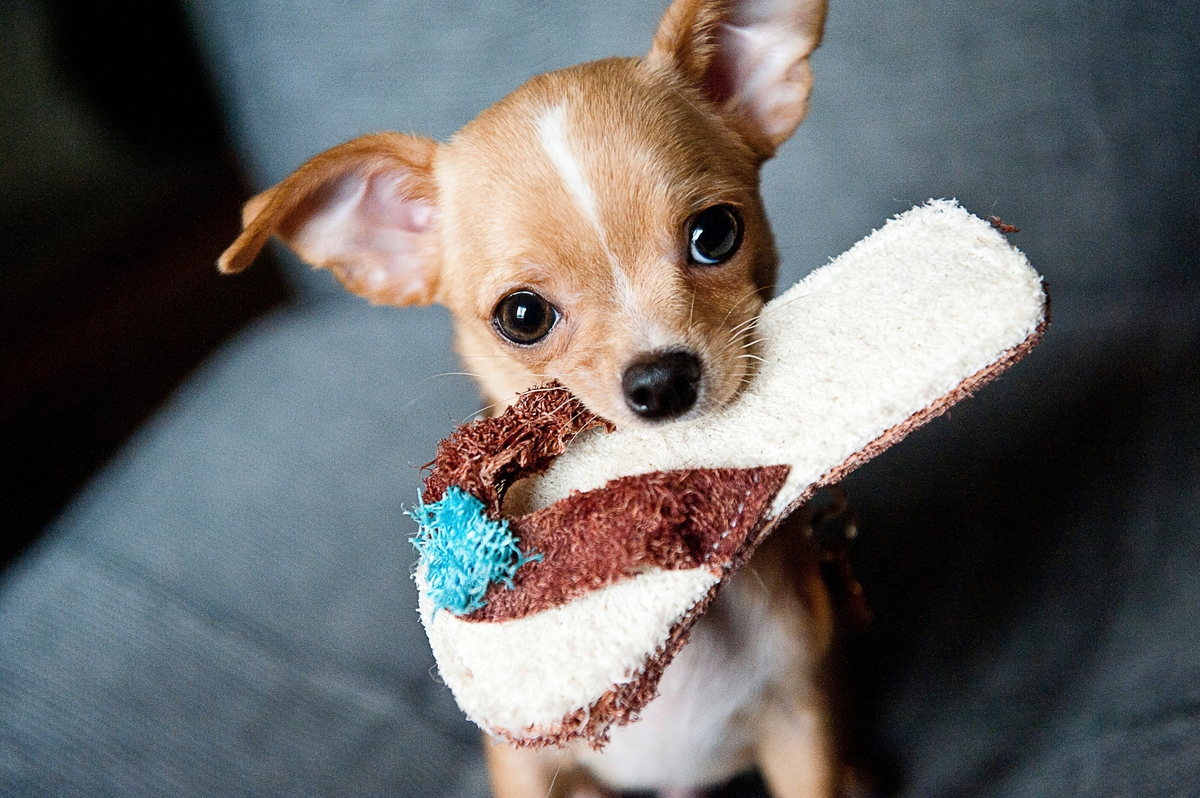
Of course, you can make this all a lot easier if you don’t tempt your dog to misbehave. Put those shoes away. Use a baby gate to keep your dog out of the dining room. Have a leash by the door, so you have some control when the doorbell rings. Or better yet, if you know someone is coming over, put your dog in his crate (if he likes it) or in a room with a Kong stuffed with his favorite foods. You get the idea. “An ounce of prevention is worth a pound of cure.”
Training
We said, in the beginning, that you can train your dog to be calm. So, what skills will help? Leave It, Watch Me, Wait, and Drop It all teach impulse control, since you are telling your dog to pay attention to you, instead of focusing on something else. You can learn these in a positive training class or from a positive trainer or training book. You can contact our free Pet Helpline if you’d like some recommendations.
The one skill that everyone wants to know, though, is “go to place” (or whatever you want to call it). Every trainer teaches it a little differently, and “shaping” (rewarding approximations toward your end goal) is a great way to teach it. For our purposes, though, here’s a way to train “go to place” that may be easier for many of you. It’s based mostly on how noted trainer, author, and speaker Pat Miller teaches it.
You may hear other trainers, even some in our resources section, recommend not using the clicker. However, clicking is the easiest way to show a dog that this is the behavior you want. Put out a mat near a comfortable sofa or chair. (That’s for you!) Toss a treat on the mat, as you say, “Go to place”. As your dog gets to his mat and is about to take the treat, click him for being on the mat. Repeat. Once your dog goes to his mat easily, tether him to a piece of furniture or a railing, and sit down close by. Make sure your dog has enough room to move around, sit, lie down, etc. Read a book or do whatever other quiet activity you want to do. If your dog isn’t settled, ignore him. When he does settle, click and toss a treat. You aren’t telling him what to do. You are rewarding behaviors that your dog initiates on his own.
If your dog starts watching you, as if focused on his next treat, stop the treats and wait. Sometimes, go over to praise or pet your dog to see if he still stays relaxed. If he gets excited, go sit down again. When he can relax for about ten minutes, take off the tether and continue clicking and treating when he remains calm.
In case you haven’t noticed, you can take your dog’s mat anywhere. Once he understands “go to mat”, you’re half way there.
Key Points to Remember
— Calm behavior can be taught.
— Arousal makes over-the-top behavior more likely, even hours later.
— Take breaks during excited play to teach your dog how to transition to more relaxed behavior.
— Clicker training is particularly effective for teaching calm behavior, since the clicker lets you catch that moment of quiet and reward it.
— Have treats with you or stashed around the house, so you can catch and reward your dog for sitting, lying down, resting on his mat, or other calm behaviors.
— If you reward a behavior you like, your dog will repeat it.
— If you reward a behavior you don’t like, even inadvertently, your dog will repeat it.
— Managing your dog’s environment can keep him from barking out the window or running around with your shoe.
— Teaching your dog skills like Leave It, Wait, Drop It, and Watch Me will help your dog learn impulse control.
— Your dog’s mat can be used as a relaxation tool, and it can be carried anywhere.
Adapted from original post from YourDogsFriend.com
NEED MORE HELP?
Contact our Pet Helpline using the button below—or call (919) 772-2326 opt 5. We're here to help!