
Separation Anxiety
Separation Anxiety in Dogs: Understanding and Treating This Common Problem
Learn about separation anxiety in dogs and proven strategies to reduce distress and promote calm independence.
Separation anxiety can be a heartbreaking and frustrating issue for many dog guardians. Dogs with separation distress may bark, destroy things, or try to escape when left alone, all because they feel unsafe or fearful without their person nearby.
The good news is that with understanding, patience, and positive training techniques, you can help your dog feel more secure and learn to relax during alone time.
This article will guide you through why separation anxiety happens, how to spot the signs, and what steps you can take to build your dog’s confidence and independence.
UNDERSTANDING SEPARATION ANXIETY
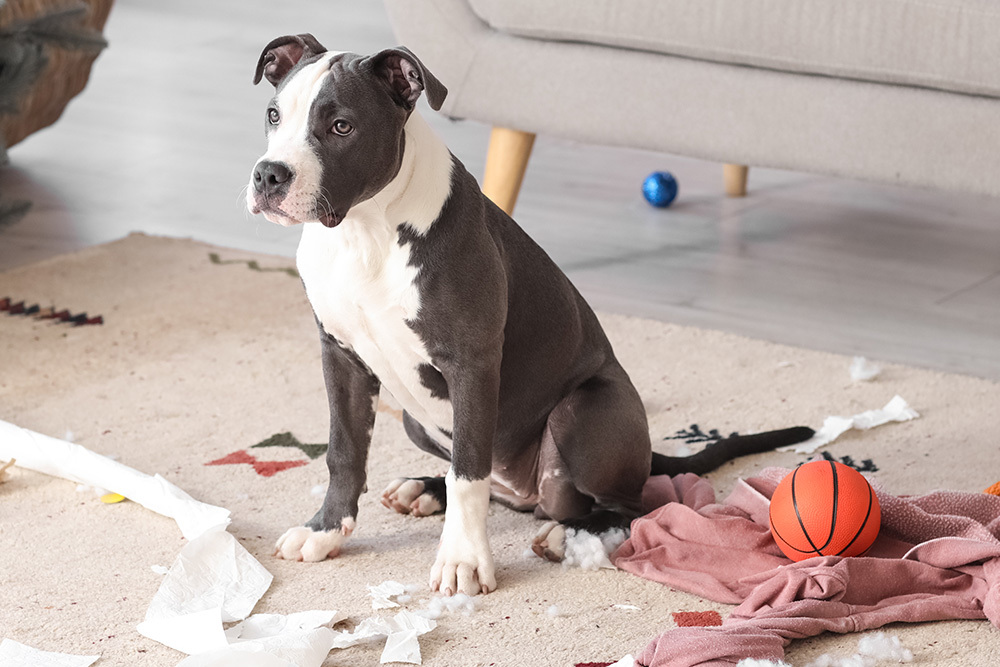
If, whenever there’s nobody at home, your dog vocalizes excessively, behaves destructively, urinates and/or defecates inappropriately, attempts to escape from his enclosure or the house itself (in extreme cases even to the point of injuring himself) he may have separation anxiety.
Separation Anxiety is a debilitating disorder that can range from mildly irksome to life-threateningly severe. Like many human anxiety disorders, it is believed that separation anxiety may be caused by an imbalance of neurochemicals. Psychotropic medications, such as Elavil (Amitriptyline,) Prozac (Fluoxetine,) Clomicalm (Clomipramine) and others have been proven effective when used in conjunction with behavior modification programs in treating this disorder. These medications can be prescribed by your dog’s veterinarian if s/he is in agreement that medical intervention is warranted.
What Separation Anxiety IS:
Terrifying, uncomfortable, dangerous, an irrational fear (analogous to human phobias), a cause of genuine suffering for the dog and his family, likely a neurochemical imbalance, a behavioral condition, a treatable condition.
What Separation Anxiety is NOT:
Vengeful, disobedient, "naughty”, stupid, intentional misbehavior, a housebreaking issue, a dog’s “fault”, a dog’s owner’s “fault”, sneakiness, premeditated mischief.
First, Investigate Your Dog's Anxiety
Using behavior modification to treat any anxiety disorder consists of several steps. First, it is important to understand that anxiety can begin quite a long time before the real cause actually occurs. A dog with separation distress may begin his “worry cycle” the moment his owner’s alarm clock goes off, or at the moment anything happens that he recognizes as a clue that means someone’s going to be leaving soon.
The first step in helping your dog overcome his fear of being by himself is to confuse the cues you are unwittingly sending that let him know your departure is pending. This is actually the fun part, and something that can be easily worked into an average day without too much advanced planning required.
How? Examples follow:
— Put on your work shoes and sit on the couch.
— Set your alarm to go off for 9:12pm. Turn it off, then take a shower
— Grab your keys, and then watch TV
— Put your jacket on; read a book.
— Fetch your purse; go to the bathroom.
— Make coffee; go to bed.
— Pack your lunch then play a video game.
— Put your dog in his crate and then nap in the recliner.
There are probably at least 25 different, tiny steps in your own personal “Leaving the House Ceremony.” Humans tend to be at least moderately obsessive about their routines, and our dogs are profoundly sensitive to these patterns. Upsetting the patterns will help your dog learn that each of the tiny steps in the Leaving Ceremony means less and less…therefore each one will contribute to his pre-alone-time anxiety buildup less and less.
Try to incorporate this exercise into your life as much as possible during the time you have at home with your dog. There is no such thing as too much repetition of this step. In fact, even after the entire program is well under way and you are seeing significant progress, you should continue mixing up your departure cues as often as you can. Remember to do it until you and your dog have had 90 consecutive days without a single unfortunate separation anxiety incident. Even then, you should begin weaning this step out of your new daily routine slowly. Re-establishing strict patterns too soon can cause a reappearance of anxious behavior!
Skip the Fuss When Coming and Going
Big farewell and reunion speeches while you’re walking out the door and immediately upon your return are triggers for a dog’s Separation Anxiety. A good idea is, instead, to cease such activities altogether, (even though it is so difficult to do!)
Instead of letting your dog know that you’re off to work, (“OK Bowser, Mommy’s got to work. You be a good boy and guard the house now and I’ll be back at 5. Watch the clock, and stay happy! See you soon, brave man!”) Try to abjectly ignore him for 5 to 10 entire minutes before you walk out the door. And instead of throwing a blissful celebration the moment you return, (“Oh, HELLO Mommy’s big boy! Who’s a good doggie?! Who’s my little man? How was your day? Look who’s a sweet baby? Who’s the smartest boy?!”) Again, pay no attention to your faithful companion when you get home until five solid minutes have elapsed.
Begin leaving the house for a second or two and coming back in without saying a single word, and repeat it as many times as you possibly can during the course of a day. Just in and out, no long pauses, no big speeches. No praise when you 3 get back, no nothing! The idea here is to get the dog to begin to understand that your coming and going is, frankly, not all that interesting and therefore, not worthy of quite so much of his attention.
Crating Can Greatly Help
For many dogs, a crate can be an invaluable component in a successful behavior modification program. Dogs are, by nature, den animals. They generally feel comfortable and secure in their crates and if that is the case, being crated leads to feelings of restfulness and security.
If, however, you have a dog whose separation anxiety is so severe that he is consistently injuring his mouth, paws, claws, or other body parts in his earnest attempts to leave the confined area, a crate may not be the best solution for your situation. A tall, secure baby gate across a kitchen doorway may be a better bet in your home.
It is, however, important that a dog with separation anxiety not be allowed the run of the house while you’re away. There are simply too many things for him to occupy himself with – much of which is likely to be inappropriate or dangerous for him, and expensive for you!
STEP-BY-STEP BEHAVIOR MODIFICATION
The next step in a successful behavior modification program for separation anxiety involves changing the dog’s perception of being left alone.
Currently, your dog thinks this time alone may, in fact, be The End Of The World As He Knows It.
Our job now is to get him to believe that in fact, being alone is something to look forward to. This is a tall order indeed – or what my grandfather would have called A Hard Sell. Convincing a bald person that he needs a hair dryer is a hard sell. Converting a devout Southern Baptist to Buddhism is a hard sell. The Hard Sell must be approached carefully and at a very slow pace…and the asking price absolutely must be an offer that your potential buyer cannot refuse.
Practice Separations
A) Find a food your dog is powerless to resist. For many dogs, Braunsweiger works wonderfully. (Pork liverwurst, available in your grocer’s hotdog/sausage roll section.) Other dogs have enjoyed success when their owners have chosen goose liver pate; melted cheddar cheese; canned chicken, or tuna. Use your imagination, and watch your dog’s reaction as you test his reaction to these treasures. The one that is his all-time favorite may cause him to drool or to chatter his jaws reflexively. His pupils may dilate noticeably when he sees it; he may dance or whine when he sees you merely walk to the place where it is kept.
B) Purchase a large, sterilized femur bone from a good Pet Shop. A femur bone is safe, as it cannot splinter. It is naturally something that dogs adore. They are generally available in several lengths; you should purchase one that seems a little too big for your dog. A femur bone is cylindrically shaped and it has a hole that runs all the way through the center.
C) Pack the hollow center of the femur bone with your dog’s absolute favorite snack. Be generous, and pack tightly! Place the filled bone in the freezer for at least 6 hours. Note: Do not be fooled by femur bones that you can purchase already filled with various “treats” from the pet store. The stuff in those bones is garbage and it never fools anxious animals. You must pack an empty femur bone yourself with something your dog is known to be silly over.
D) After the bone is frozen well, retrieve it from the freezer and take it to the area where your dog will be confined when you leave. Confine the dog with the bone and leave the room (not the house!) for exactly 45 seconds. No matter what your dog is doing, return immediately after 45 seconds has elapsed, retrieve the bone, release your dog, and put the bone back in the freezer.
E) Ignore your dog completely for 3 minutes.
F) Re-retrieve the frozen bone. Re-confine your dog, and re-leave the room (NOT THE HOUSE!) for 45 seconds. Return immediately at the end of 45 seconds, remove the bone; release the dog.
G) Again, ignore your dog for 3 minutes.
H) Note: In order to effectively ignore a dog, you must absolutely avoid verbalization, (no talking!) avoid all eye contact, and avoid all physical contact. (No touching!) The dog should have no toys to play with during these three minutes. The television and the radio should be off. You should be engaged in something that completely excludes the dog, (like reading a book, paying bills, etc.)
I) Repeat F & G (while bearing H in mind!) until your dog will reliably stay calm and quiet for your entire 45-second absence for 5 consecutive repetitions.
J) Following the same steps as above, increase your out-of-room time interval to 60 seconds. If your dog succeeds at 60 seconds, (i.e., remains calm and quiet,) repeat until there are 5 consecutive successful run-throughs at this step. If your dog does not succeed, (i.e.: he begins to pace, vocalize, panic, bark, chew, urinate, defecate, attempt to escape, etc.) before the 60 seconds has ended, return to the dog; remove the bone; release the dog; ignore him for three full minutes; and then return to the 45-second step. If successful, repeat at 45 seconds until you get success 5x/row. If not, reduce your “absence-time” to 30 seconds, and gradually work back up from there.
K) Once your dog has mastered the 60-second step, graduate by another small increment of time. Try to go from 60 to 90 seconds. After 5 successful attempts at the 90-second step, attempt 2 minutes. After 5 successful 2-minute repetitions, attempt 3 minutes. After 5 successful 3-minute intervals, attempt jumping to 5 minutes. Again, you’ll need 5 successful 5-minute sessions before moving on, the next step will likely be 7 minutes. From 7 minutes, graduate to 10, and from 10 minutes, to 15. Remember, none of these absences are real. You are only leaving the room and your dog's sight; You are not actually leaving the house!
Clearly, the best way to implement this kind of graduated interval, slow desensitization process is to set aside several days wherein you are not expected to be anyplace else! Frequently, families will begin with one member taking off on a Friday, working through the steps as much as possible and then continuing through the weekend. Then, the other adult member will take Monday off to continue from 5 where things ended up over the weekend and finally by Tuesday, the dog is generally ready to handle short periods of time all alone so a pet-sitter can be hired to stop by for steadily decreasing numbers of visits per workday until the following weekend. If you have vacation time you haven’t taken, that is another good way to tackle the timing of this type of program. Some people are able to arrange for slightly longer lunch hours so they can go home and tend to the training. Others are able to arrange late arrival and early departure times.
You will have to decide how to best fit the behavior modification plans into your schedule and while thinking of a way to do so, remember that your dog is suffering with a treatable disorder. The behavior modification program is temporary. If it isn’t implemented, the separation anxiety may be permanent. Behavior problems similar to this one are the number one killer of pet animals in our country every year. Frequently, if separation anxiety isn’t successfully treated, the animals that are affected by it are euthanised.
The times that you’ll be leaving the dog in his Safe Area with his super-special femur bone without actually leaving the house are called Practice Separations. They are designed to be much easier for a dog to handle than when he is left truly alone in the house. Once you have reached the 15-minute point in the Practice Separation portion of the program, it is time to begin adding Real Separations very gradually, and in conjunction with the much longer Practice runs.
Real Separations at first involve the owner walking out the front door (or whichever door they usually use when they’re leaving for the day) and returning almost immediately.
Eventually, as the Real Separations become longer, the owner should begin to actually leave the premises – drive to the end of the street and back, or around the block, or to the convenience store to pick up some milk, etc.
The following chart illustrates, in terms of time, an example of incorporating Practice Separations with Real Separations (see table below).
Add in Real Separations
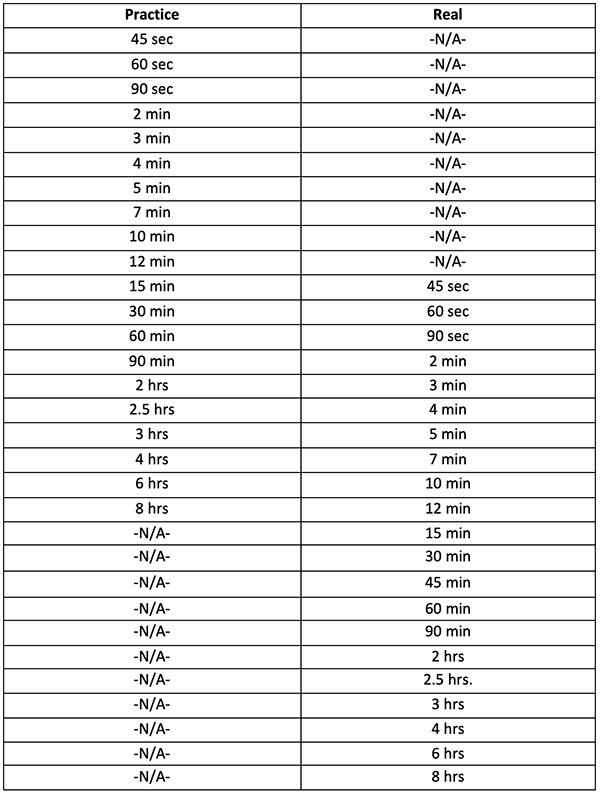
— These steps are to be used together with the exercises described earlier in this discussion, rather than instead of or after those exercises.
— Each dog is an individual who will progress at his own speed. The time intervals described above and in the following table are guidelines only. Make sure you aren’t expecting more of your dog than he is able to give.
— If you graduate to a new level and your dog has trouble succeeding, return to the level he last mastered, review it at least three times, and then make your next increment smaller. For instance, if your dog was successful five times in a row at 30 minutes but he had difficulty on his first attempt at 45 minutes, return to the 30-minute step, repeat it three times, and then graduate to 35 minutes. Move on from there. Patience will bring on more lasting success than pushiness!
When we modify a behavior that our subject has faithfully believed in and rigorously practiced for long periods of time, it is common for us to see recurrences of those old behaviors periodically. If it happens, don’t panic! Simply return to the above steps for the duration of your dog’s regression. He simply needs a review period, and that is normal.
As his newly learned behaviors become habits, these fallbacks will become fewer and farther between and their durations will be progressively shorter.
Once you have had 90-120 consecutive days without a single incidence of regression, you can begin to relax a bit and start to believe that your efforts have been fruitful. At this point it may very well mean that your dog’s new, calm acceptance of alone-time is indeed becoming a habit and if he has been treated with antidepressants it may be time to speak to your veterinarian about beginning the gradual weaning process that must be followed when psychotropic medications are stopped. Never cease antidepressant therapy abruptly! Many animals treated with medications for anxiety stay on their prescriptions for 6 months or longer. Some may continue on their medicines for many years.
Note for the Long-Term
If a decade passes and your dog shows no sign, ever, of having had an anxiety disorder in his younger days, you still need to be cognizant of the fact that animals (and people!) who suffered from anxiety are believed by many psychiatrists and behaviorists to be the most prone to develop similar disorders in the future.
Once you have taken care of the separation anxiety issue, make sure that the vast majority of your dog’s life experiences are positive and non-threatening. Choose non-aversive trainers, veterinarians, and groomers. Make sure the kennels where he is boarded have caring staff members and programs that include lots of dog-human interaction. Take vacations in the car, and bring your dog along when possible. Expose him to as many environmental stimuli as you can think of, as often as possible, and praise and reinforce him whenever he explores a new person or a new object on his own. (Bicycles, children, people in uniforms, puppies, cats, traffic, skates, skateboards, motorcycles, wheelchairs…all of these things can be terrifying if a dog lacks exposure to them!) Avoid forcing your dog to try something that seems to be frightening to him. If he’s afraid to walk into a new building or onto an elevator, etc., don’t shove, don’t pull. Wait. Let him watch others go in and out. Use food reinforcements. Take care not to pay too much attention to him when he’s worrying…but be willing to allow him to decide on his own that he wants to take a chance. Make sure he knows that you’re thrilled when he does.
If you have any questions about the above, or if you have trouble implementing the program as it is described, please contact a veterinarian or a qualified behaviorist in your area, or use the button below to get free help from our Pet Helpline.
NEED MORE HELP?
Contact our Pet Helpline using the button below—or call (919) 772-2326 opt 5. We're here to help!