
Jumpy Dogs
Tired of Your Dog Jumping on Everyone? Here's What to Do
Teach your dog polite greetings and calm behavior with positive, effective training techniques.
While it might seem cute when a dog jumps up to say hello, jumping can quickly become a frustrating — and even dangerous — habit, especially with larger dogs.
Teaching your dog to greet people calmly is an important part of building good manners and keeping everyone safe and comfortable. With positive reinforcement and consistent training, you can help your dog learn more polite ways to show excitement and affection.
This article will guide you through understanding why dogs jump and how to redirect that energy into more appropriate greetings.
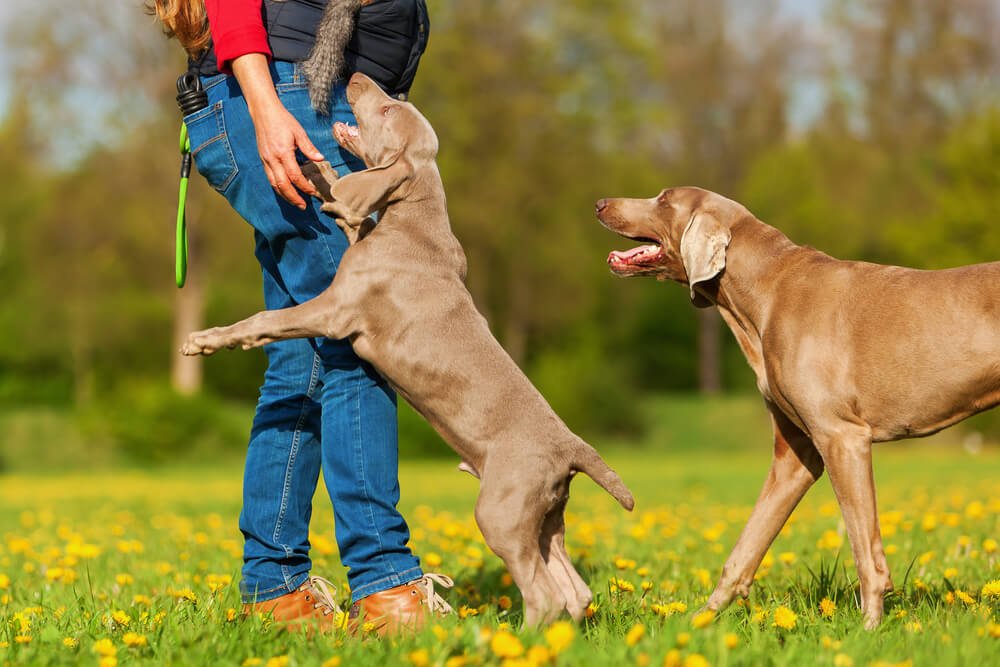
STOP DOGS FROM JUMPING THE FORCE-FREE WAY
What are Positive and Negative Reinforcement?
Rrrrriiinnnnnnng, rrrrrriiiiinnnngggggg! “Hello. My dog is wonderful and friendly but he jumps on guests when they come into the house and it’s very difficult to get him to calm down. We’ve tried yelling “no,” and “down,” we’ve tried stepping on his back feet, we’ve tried kneeing him in the chest, we even tried bonking his head with an empty foil pie plate when he jumped up, but negative reinforcement doesn’t seem to be working. What are we doing wrong?”
As it turns out, there are two problems here, and the smaller of the two is the dog’s jumping behavior. The more dangerous issue at work is the common misconception (and misuse!) of the term “negative reinforcement.” So, at the risk of writing an unforgivably geeky behavior advice column, I am going to take this opportunity to set the record straight on conditioning.
Reinforcement always makes a behavior more likely to be repeated. Always! Therefore, attempting to eliminate a behavior by reinforcing it is as sensible as going on strict diet of cheesecake and fried snickers bars in order to lose weight.
The words positive and negative are qualitative, in terms of behavior modification and learning theory. It’s easy to think of positive and negative as synonyms for good and bad, respectively, but that kind of qualification isn’t necessary here, and it serves only to complicate things!
Positive reinforcement always means adding something to a situation in order to make an exhibited behavior more likely to be repeated.
Negative reinforcement is a way to get more of something from your dog – but it’s tricky (and frequently not very nice) to implement, because it requires a trainer to take away something a dog doesn’t like in order to make a particular behavior happen more often.
Sound confusing? It is, kind of. But simply put, you can’t reinforce a behavior away.
Why Positive and Negative Reinforcement are NOT the Answer
What Negative Reinforcement Looks Like:
Back in the not-so-golden olden days of dog training, the Retrieve was commonly taught using negative reinforcement. The steps went a little something like this:
— Put a retrievable object in a dog’s mouth.
— Bend the dog’s ear over and pinch it really, really hard
— Wait for the dog to yelp and gasp in pain
— Because yelping and gasping generally require an open mouth, at this point your retrieve object should basically fall into your hand.
— Release the pinch-pressure.
Not very friendly, was it? But it was negative reinforcement. An aversive (unliked) stimulus ceases (taken away; negative) so that a particular behavior (dropping the retrieve object) becomes more likely to happen again. The olden-day trainer’s message to the dog? “Let go of that when I put my hand by your mouth and do it fast or I’m going to keep pinching your ear forever.” Please note: this is not a technique I recommend!
What Positive Reinforcement Looks Like:
These days, we generally train the retrieve and release with a trade-off – swapping a tastier object for the one the dog already has. It works nicely…because it is nice. It’s positive reinforcement. We’re adding something a dog likes (tasty morsel) in order to make a behavior that we like (releasing the object) more likely to happen again.
Today’s trainer’s message to the dog? “If you give me that thing when I ask you for it, something very cool will happen.” It’s more fun for everyone involved. And as a bonus, it’s faster and more effective, too, because a dog learns to release what he’s got because he wants to and not because he’s afraid of what will happen to him if he doesn’t.
So. Let’s look at the situation our dog owner with the jumping issue presents. Is the handler adding something, or taking something away from her scenario? Well, she’s tried a knee in the chest, a pie tin to the noggin, a couple of verbal admonitions, and the tricky Back Foot Stomp. For one thing, this poor dog owner is working an awful lot harder than she really needs to. She’s adding aversive stimuli to her situation – ergo, it isn’t negative, friends. That’s Positive. Even though what she’s adding is icky, it’s being added, so it counts as “plus.” (Dog jumps + something rotten happens.)
What are Positive and Negative Punishment?
Now. Is our caller’s intention to increase, or decrease a behavior? She said she’d like him to calm down, so it’s safe to assume that she’d like less jumping. Therefore, she doesn’t want to use reinforcement at all, whether it’s positive or negative!
What Positive Punishment Looks Like
Her yelling/foot-stepping/chest-kneeing techniques, all of which are sometimes still advised by several people in my field, are all examples of punishment, because they’re designed to make a behavior less likely to recur. And they’re not working. Instead of the “negative reinforcement,” she thought she was using, this owner’s attempts have all fallen under the heading of Positive Punishment. Wait…what? Punishment can be positive? Well sure. Remember: Positive and negative simply mean plus and minus, in terms of conditioning. Positive punishment means adding an aversive stimulus in order to reduce repetition of a particular behavior.
Does positive punishment ever work? Yes, I’m afraid it does, sometimes, but if and only if it’s applied exactly correctly, with exquisite timing, ideal intensity for the individual dog, and perfect consistency. Positive punishment isn’t only mean and scary for the dog. It’s also really, really hard to implement effectively.
What Negative Reinforcement Looks like (and Why it's the Answer!)
The good news is that it’s unnecessary to bother traveling down that particular road anyway, because there is a much easier, much kinder way to decrease behavior that doesn’t require causing your dog to experience pain or fear. Guesses? Negative punishment.
By this point I’m sure you’ve all got the hang of this, so defining negative punishment will be easy for you. Negative punishment simply means removing something from the environment in order to make an exhibited behavior less likely to be repeated.
All species repeat the behaviors that are the most rewarding. (The most reinforced.) There’s something about jumping that this dog likes, and it’s probably attention. Therefore, a very easy, very humane, and very effective way to reduce and eventually eliminate jumping is by removing yourself from the situation as soon as your dog’s front feet leave the floor.
It will go like this:
You: “Hello there, doggie.”
Fido: Hellohellohello I love you wagwagwag BOUNCE
You: “Oops. Too bad!” (leave the room) (Wait 30 seconds. Return)
You: “Hello there, doggie.”
Fido: Oh hellohellohello I love you please stay there wagwagwag BOU…sit
You: “Gooooood dog!” (Shower with affection)
And of course, repeat, repeat, repeat. The more times the better. There is no such thing as “too much practice” for this exercise.
Make sure that you’re paying the dog with what he wants (attention) as soon as he gives you what you want (four feet on the floor.)
Have your friends and neighbors behave the same way when they come to visit. Ask people on the bike trail and at the dog park to practice with you. Come to the adoption center and ask the volunteers and staff to practice with you. Make sure that it’s always exponentially more rewarding for your dog to sit than it is for him to jump.
All species repeat the behaviors that are the most rewarding. (Sound familiar? If not, read this whole article again!) It’s usually no more complicated than that.
— Molly Stone, CDBC, SPCA Wake
NEED MORE HELP?
Contact our Pet Helpline using the button below—or call (919) 772-2326 opt 5. We're here to help!